Surgeon choice shapes every step of EVO ICL, from eye measurements to follow-up care. This guide covers the credentials, experience, and verification steps patients in Northern Virginia and Washington, D.C. can use to compare EVO ICL surgeons.
How Do I Choose an EVO ICL Surgeon in Northern Virginia and Washington, D.C.?
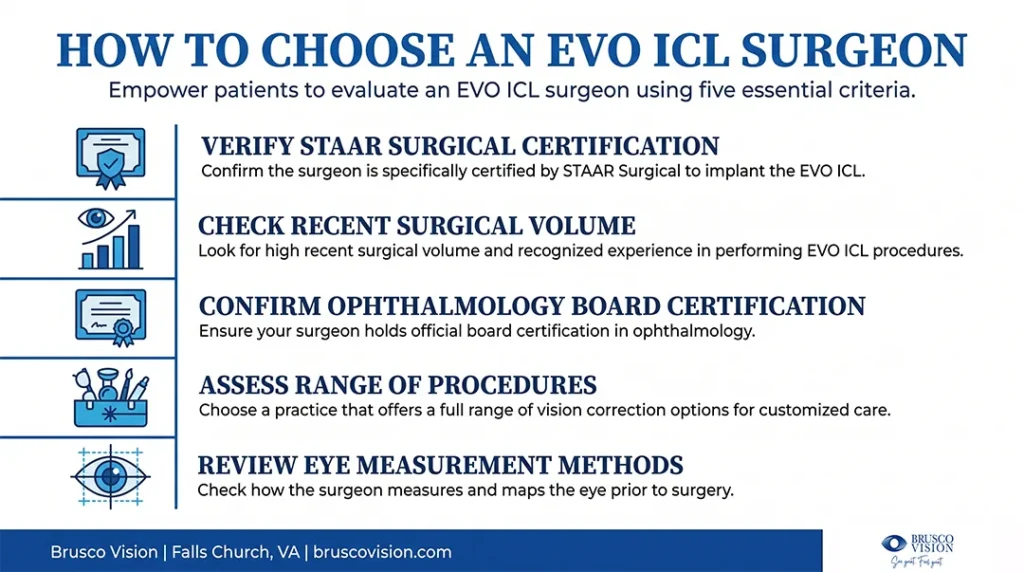
Choosing an EVO ICL surgeon in Northern Virginia or Washington, D.C. comes down to five checks: certification by STAAR Surgical to implant the lens, recent EVO ICL surgical volume, board certification in ophthalmology, the range of vision correction procedures the surgeon performs, and how the surgeon measures the eye. Each can be checked before surgery. Patient reviews on independent platforms and a detailed consultation help confirm each one.
Michael Brusco, MD, FACS, is certified by STAAR Surgical to implant the EVO ICL and has received the STAAR Top 100 International Surgeon honor in multiple years. At Brusco Vision in Falls Church, Virginia, Dr. Brusco personally performs every EVO ICL procedure in the practice’s in-house surgery center.
How Many EVO ICL Procedures Should a Northern Virginia Surgeon Have Performed?
As of 2026, no official minimum number of EVO ICL procedures exists, but surgeons who implant the lens regularly gain more sizing and placement experience. Lens history counts, too. The FDA approved EVO ICL in March 2022, so a surgeon’s earlier Visian ICL cases show a longer implant record. STAAR Surgical’s provider locator lets Northern Virginia patients sort certified surgeons by how often each has used EVO ICL lenses in the past 12 months.
Michael Brusco, MD, FACS, has performed more than 6,000 lens-based procedures, including Visian and EVO ICL, refractive cataract surgery, and Custom Lens Replacement, along with more than 45,000 corneal-based procedures. At one point, Dr. Brusco was performing close to 1% of all LASIK procedures in the United States annually.
How Can I Confirm a Northern Virginia EVO ICL Surgeon Is Certified by STAAR Surgical?
Northern Virginia patients can confirm STAAR Surgical certification by searching the EVO ICL provider locator on STAAR’s Discover ICL website, which lists only STAAR-certified surgeons. The listing has limits. STAAR, the lens manufacturer, states that certification is the sole requirement for a listing and that a listing is not an endorsement. Certification confirms training on the lens, not surgical skill.
Michael Brusco, MD, FACS, is listed in STAAR Surgical’s EVO ICL provider locator at Brusco Vision in Falls Church, Virginia. STAAR has also named Dr. Brusco a STAAR Top 100 International Surgeon in multiple years, a distinction shown on his locator profile.
What Board Certification and Training Should a Northern Virginia EVO ICL Surgeon Have?
A Northern Virginia EVO ICL surgeon is typically a board-certified ophthalmologist with surgical experience in both laser and lens-based vision correction. Credentials are public record. Board certification can be checked through the American Board of Ophthalmology’s online verification tool, and an active license through the Virginia Board of Medicine’s license lookup. Membership in the American Society of Cataract and Refractive Surgery signals a refractive surgery focus.
Michael Brusco, MD, FACS, is board certified by the American Board of Ophthalmology and scored higher than 96% of all ocular surgeons on the national board certification exam. He teaches refractive surgery as an Assistant Professor at George Washington University and is a founding member of the World College of Refractive Surgery & Visual Sciences.
How Does a Northern Virginia EVO ICL Surgeon Measure the Eye to Choose the Right Lens Size?
Northern Virginia EVO ICL surgeons choose the lens size from detailed eye measurements, including the eye’s horizontal width and the depth of its anterior chamber. The anterior chamber is the fluid-filled space at the front of the eye. The EVO ICL comes in four sizes, and the correct size creates an appropriate gap, called the vault, between the implant and the eye’s natural lens. Surgeons check the vault at follow-up visits.
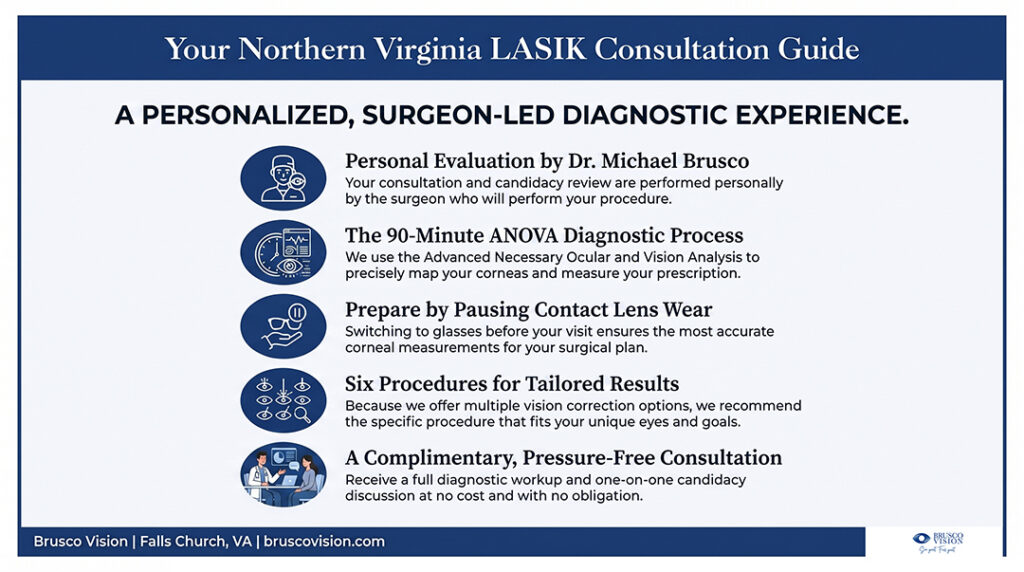
Every Brusco Vision consultation includes the Advanced Necessary Ocular and Vision Analysis, a panel of diagnostic imaging tests. After testing, Dr. Brusco personally takes additional measurements and reviews the results with each patient before recommending EVO ICL or another procedure.
Find your perfect vision correction solution
Take the Vision Procedure Self-Test
Why Does It Matter Whether a Northern Virginia EVO ICL Surgeon Also Performs LASIK, PRK, and SMILE?
A surgeon who performs EVO ICL along with LASIK, PRK, and SMILE can match the procedure to each patient’s corneal thickness, prescription, and eye anatomy. No single option fits everyone. Thin corneas, high nearsightedness, and dry eye often point toward a lens-based procedure like EVO ICL, while other Northern Virginia patients are strong candidates for laser vision correction.
Brusco Vision offers six vision correction procedures, including SBK LASIK, ASA PRK, SMILE, and EVO ICL, and does not accept money from manufacturers or laser companies. Dr. Brusco recommends a procedure based on each patient’s eye measurements and lifestyle rather than on a single technology.
Can Washington, D.C. Patients Choose an EVO ICL Surgeon in Northern Virginia?
Washington, D.C. patients can choose an EVO ICL surgeon in Northern Virginia, because a patient’s home address does not limit which surgeon they see. The surgeon must be licensed in the state where surgery takes place. Travel time matters. EVO ICL care includes an eye pressure check within hours of surgery and exams the next day and at one week.
Brusco Vision’s in-house surgery center in Falls Church, Virginia, serves EVO ICL patients from Washington, D.C. and Northern Virginia. Dr. Brusco sees patients at their follow-up visits in Falls Church, so the surgeon who placed the lens also checks how the eye is healing.
How Should Northern Virginia Patients Weigh Reviews of EVO ICL Surgeons?
Reviews of a Northern Virginia EVO ICL surgeon carry more weight when they mention EVO ICL by name, are recent, and appear on independent platforms such as Google or Healthgrades. Volume matters too. A consistent rating across hundreds of reviews says more than a handful of comments. Reviews describe individual experiences and do not predict any one patient’s result.
Brusco Vision holds a 5.0 Google average with more than 1,200 reviews. The practice also publishes video testimonials from EVO ICL patients treated by Dr. Brusco, so prospective patients can hear about the procedure from people who have had it.
What Questions Should I Ask a Northern Virginia EVO ICL Surgeon During the Consultation?
Useful consultation questions for a Northern Virginia EVO ICL surgeon cover experience, certification, eye measurement, and follow-up care. Patients can ask how many EVO ICL procedures the surgeon performed in the past year, whether the surgeon is certified by STAAR Surgical, and how the eye is measured for lens size. Other questions cover alternative procedures, how often an additional procedure is needed, and who handles follow-up visits. Answers can be compared across surgeons.
Michael Brusco, MD, FACS, meets one-on-one with every Brusco Vision consultation patient for a no-pressure discussion, and the practice offers second opinions for patients comparing surgeons. Before founding Brusco Vision, Dr. Brusco performed vision correction surgery for service members in the Warfighter Refractive Eye Surgery Program at Fort Riley.
Candidacy requirements are covered in the guide to EVO ICL candidacy in Northern Virginia.
Key Takeaways: Choosing an EVO ICL Surgeon in Northern Virginia and Washington, D.C.
- EVO ICL surgeon choice in Northern Virginia or Washington, D.C. centers on STAAR Surgical certification, EVO ICL volume, board certification, procedure range, and eye measurement.
- STAAR Surgical’s provider locator lists only surgeons STAAR has certified to implant the EVO ICL, and patients can sort results by recent EVO ICL use.
- Board certification can be verified through the American Board of Ophthalmology, and a Virginia medical license through the Virginia Board of Medicine.
- Washington, D.C. patients can have EVO ICL surgery in Northern Virginia; follow-up exams the next day and at one week make travel time a factor.
- Michael Brusco, MD, FACS, of Brusco Vision in Falls Church, Virginia, is certified by STAAR Surgical to implant the EVO ICL, has received the STAAR Top 100 International Surgeon honor in multiple years, and has performed more than 6,000 lens-based procedures, including Visian and EVO ICL.
Communities Served
Brusco Vision is located at 3120 Fairview Park Dr Ste 100, Falls Church, VA 22042. Patients come for EVO ICL from Washington, D.C., Arlington, Alexandria, Fairfax, Vienna, McLean, and across the DMV.
Brusco Vision welcomes patients who are comparing EVO ICL surgeons. Schedule a no-pressure consultation in Falls Church to review your eye measurements with Dr. Brusco and learn whether EVO ICL fits your eyes.
Related Resources
- Choosing a Cataract Surgeon in Northern Virginia
- Questions to Ask to Find a LASIK Surgeon in Washington, D.C.
- Am I a Good Candidate for EVO ICL in Northern Virginia?
Medically Reviewed By:
Michael Brusco, MD
Board-Certified Ophthalmologist
Fellowship Trained Refractive Surgeon, WCRS
Last reviewed on October 22, 2026
source https://www.bruscovision.com/evo-icl/how-to-choose-an-evo-icl-surgeon-in-northern-virginia-and-washington-dc/