A high prescription raises a practical question before choosing vision correction: how much nearsightedness, farsightedness, or astigmatism can LASIK actually treat? Just as important is what the options are when a prescription runs past that range.
Can I get LASIK with a high prescription?
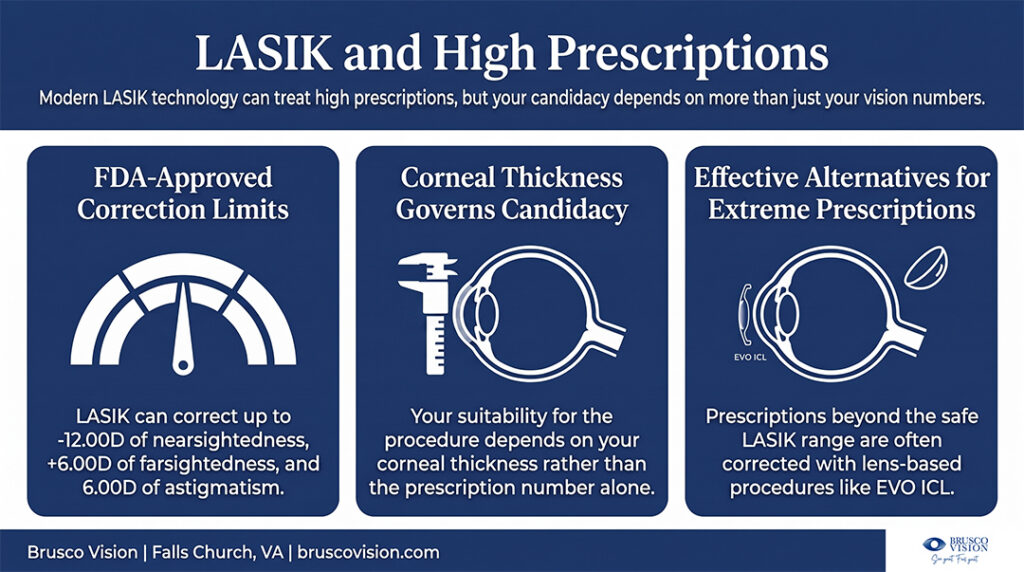
As of 2026, LASIK can correct high prescriptions within FDA-approved limits, commonly up to about −12.00 diopters of nearsightedness, +6.00 diopters of farsightedness, and 6.00 diopters of astigmatism, though most surgeons apply more conservative practical thresholds. Candidacy depends on corneal thickness, not the prescription number alone. Prescriptions beyond the safe range are often corrected with a lens-based procedure such as EVO ICL.
What prescription is too high for LASIK?
A prescription is generally considered too high for LASIK when nearsightedness exceeds about −8.00 to −10.00 diopters, farsightedness exceeds about +5.00 to +6.00 diopters, or astigmatism exceeds about 6.00 diopters, though the exact cutoff depends on individual corneal thickness. High myopia — defined as −6.00 diopters or greater — doesn’t automatically rule out LASIK. As of 2026, a corneal evaluation determines whether enough tissue remains to reshape the eye safely.
How does EVO ICL compare to LASIK for high prescriptions?
EVO ICL corrects a wider range of nearsightedness than LASIK — FDA-approved from −3.0 up to −20.0 diopters, compared with roughly −12.0 diopters for LASIK — which makes it a common option for very high prescriptions. Instead of removing corneal tissue, EVO ICL places a soft implantable lens inside the eye, preserving the cornea. This makes it suitable for many patients whose prescription or corneal thickness falls outside the LASIK range.
STAAR reported in 2026 that EVO ICL accounted for more than 70% of procedures in patients −8.0 diopters and above across 19 leading refractive practices.
Why does a high prescription make LASIK harder?
A higher prescription requires removing more corneal tissue, which is why LASIK becomes harder as the numbers climb. Each diopter of nearsighted correction removes roughly 12 to 16 microns of tissue, so a −10.00 diopter correction can remove 120 to 160 microns of an average cornea measuring about 540 microns. Surgeons preserve enough tissue to keep the cornea structurally stable.
Is regression or an enhancement more likely with a high prescription?
Higher prescriptions carry a somewhat greater chance of residual refractive error or regression over time, which can make an enhancement procedure more likely than with lower prescriptions. Enhancement rates vary by prescription strength and surgical platform and are confirmed during evaluation. Regression occurs when the eye’s focusing power shifts after surgery, and it is more common at the upper end of the treatment range.
Find your perfect vision correction solution
Take the Vision Procedure Self-Test
Does a high prescription affect candidacy if you also have thin corneas?
A high prescription combined with thin corneas further limits LASIK candidacy, because both factors reduce the corneal tissue available for reshaping. When the cornea is too thin to correct a high prescription safely, surface procedures such as PRK or lens-based options such as EVO ICL — which does not remove corneal tissue — are often considered instead. A corneal thickness measurement, called pachymetry, is part of the evaluation.
Will high-prescription patients be fully glasses-free, or is some residual correction likely?
Many high-prescription patients achieve a substantial reduction in dependence on glasses and contacts, though some residual correction is more likely than with lower prescriptions. Outcomes vary by individual and are discussed during a consultation. Correcting distance vision also doesn’t address presbyopia, so reading glasses may still be needed with age. Realistic expectations come from preoperative measurements rather than the prescription number alone.
What outcomes do high-prescription patients actually achieve?
High-prescription patients treated within approved ranges typically achieve strong distance-vision outcomes, with most reaching 20/40 or better and many reaching 20/20 in clinical studies. Specific outcome figures depend on the procedure and prescription. A three-year FDA study of EVO ICL reported a strong safety profile. Individual results depend on eye anatomy, prescription, and procedure selection, which are reviewed during a consultation.
Key Takeaways: LASIK and High Prescriptions
LASIK is FDA-approved to correct nearsightedness up to about −12.00 diopters, farsightedness up to +6.00 diopters, and astigmatism up to 6.00 diopters, though practical limits depend on corneal thickness.
A prescription is generally “too high” for LASIK beyond about −8.00 to −10.00 diopters of myopia; high myopia does not automatically disqualify a candidate.
EVO ICL corrects nearsightedness from −3.0 up to −20.0 diopters by placing an implantable lens inside the eye, preserving the cornea — a common option when a prescription exceeds the LASIK range.
Thin corneas combined with a high prescription further limit LASIK; surface procedures (PRK) or lens-based options (EVO ICL) may be considered instead.
Candidacy is determined by corneal measurements during a consultation, not by the prescription number alone.
At Brusco Vision, board-certified ophthalmologist Dr. Michael Brusco, MD, FACS, has performed more than 45,000 corneal-based and 6,000 lens-based vision correction procedures — previously, close to 1% of all LASIK performed in the United States each year. An assistant professor at George Washington University Department of Ophthalmology, Dr. Brusco founded the first practice of its kind in Washington, DC and the DMV. Brusco Vision offers six vision correction procedures and doesn’t accept funding from lens or laser manufacturers, allowing unbiased recommendations for patients whose prescription falls outside the standard LASIK range.
If a high prescription has raised questions about your candidacy, a consultation at Brusco Vision in the DMV can determine whether LASIK, EVO ICL, or another option fits your eyes.
Medically Reviewed By:
Michael Brusco, MD
Board-Certified Ophthalmologist
Fellowship Trained Refractive Surgeon, WCRS
Last reviewed on August 6, 2026
source https://www.bruscovision.com/lasik/can-i-get-lasik-with-a-high-prescription/


No comments:
Post a Comment